Reflections on the Rule - January 2026


“Whoever listens to you listens to Me” (Luke 10:16)

Dr. Brandon Beck

Lay Chaplain, COHI

Monk, The OOOW

Church of reconciliation, san antonio, TX

Theology Student, Brite Divinity School

This verse of Luke is quoted by Benedict under the heading of Obedience, part of our January reading cycle. (p 58 in the Sutera translation with commentary)

Obedience is all about listening. Sister Judith (Sutera), in her commentary for January 22, reminds us that “the word ‘obedience’ shares a common root with the Latin word for hearing/listening.” (p 57-8)

As a teacher, I often remind my students that we cannot listen well to each other in the classroom when we are preparing our answer in our head during another student’s turn to share. I remind students of this knowing from my own experience as a student that this is a nearly impossible task. I offer more than reminders; I create opportunities to practice by allowing students time to think and write as a group before they share individually in order to allow them to focus on each other rather than to be thinking about what they will say when it is their turn. I take out the guess work of when their turn will come by sharing the speaking order ahead of time, and I assure them that passing or skipping until later is always ok. Still, listening to each other in class rather than thinking of what we will say when it is our turn is not easy.

As pastoral care providers and lay chaplains, I wonder what we do to better listen in pastoral care settings? What tools do we have to be obedient to God in the moment, to hear Jesus in the voice of our care recipient so that, in turn, they can hear Jesus in our voice? Another question we might ask ourselves is, simply, how do we use our good listening to get out of the way to let God do what God does?

I learned recently that the word tolerant is derived from Latin tolle or tolerare which mean, respectively, “to lift/remove” and “to bear.” I’ve never thought of the word “tolerate” in this way. With this new derivation in mind, I am coming to think of Jesus as tolerating the cross. If I am to be like Jesus, “to accept this sin sick world as it is and not as I would have it” (Niebuhr, Serenity Prayer), then am I not called to “tolerate” also?

Perhaps that is the greatest tool, then, that I have in my obedience and listening. I must tolerate, first, myself and my own thought process. I must lift and remove myself from the situation. Then, I must tolerate that which I am receiving. I must bear the words I hear.

Whether I am in a classroom waiting my turn to share, I am listening in pastoral care, or living in this sin sick world, I can lift and bear it. I can tolerate it. Can you?

 

COHI Board is seeking New Volunteers

On October 10-11, the COHI Board gathered in Buford, GA, for an in-person meeting to get acquainted with new members and plan for future steps in administering the Trinity Wall Street grant. We enthusiastically welcomed new Board Members, Diane Hodgins as Secretary, and Craig Wilson as Interim-Membership Committee Chair.

Part of our planning was to revisit and clarify the Board Committee structure as created in 2022 during an organizational redevelopment initiative. We are seeking new members for the Communication, Finance, and Curriculum Committees, as well as new Regional Representatives for West/Northwest, Gulf Coast, Heartland, North Atlantic, and Southwest Regions to serve on the Membership Committee.

Please read the committee overviews and preferred skill sets below and prayerfully consider volunteering for one of the committee positions. Send your questions and decisions to communications@cohi.org.


Committee Assignments and Preferred Skill Sets

Curriculum/Charism Committee

The Curriculum and Charism Committee’s responsibilities include: 

  • Writing, researching, and editing all learning materials

  • Creating & Implementing Continuing Education opportunities, including Facilitator Trainings and Leaning In Events

  • Charism- Ensuring consistency of COHI's unique identity and Benedictine spirituality across all resources

  • Annual Conference planning is a subcommittee

Skill set preferred:

  • Event planning, content development, and strong administrative skills.

Send your questions and decisions to communications@cohi.org.


Membership Committee

The Membership Committee is made up of the Membership Chair,  Membership Administrator, and Regional Representatives. 

  • This committee is charged with ensuring the Membership Chair, Membership Administrator and Regional Representatives have clearly identified written roles and responsibilities along with a communication plan for engagement as appropriate with the COHI board members, COHI centers and inquirers.

Primary responsibilities of Regional Representatives include:

  • Acting as liaison between Centers and the Board through regular communications, including attending Reg. Representative meetings

  • Listening, encouraging, and problem-solving with Centers, Regional Representatives, Membership Chair, and Membership Coordinator 

  • Encouraging Centers to participate in COHI and Regional events

  • Facilitating coordination between Centers to share resources

  • Participating in Centers’ Circles of Care, commissioning, retreats, etc. as needed and if invited

  • Planning and participating in Regional and COHI retreats, conferences and training (including lay pastoral care training, facilitator training, leadership training)

  • Promoting COHI within respective regions to interested organizations 

Skill set preferred:

  • Commitment to Benedictine spirituality, effective oral and modern written communication skills, and comfortable holding virtual meetings (Zoom). It’s not required for you to be the host; someone in your church, or you can partner with another Center to do the technical pieces.

Send your questions and decisions to communications@cohi.org.


Finance Committee

The Finance Committee will be made up of the Finance Committee Chair, committee members, and the Treasurer.

This committee will work with the Treasurer on COHI’s budget plans, grant opportunities, existing grants, and fundraising campaigns created by the Communication Committee. They will also work with our grant contractors. 

Skill set preferred:

Knowledge of budgets and money matters, preferably with experience on a finance committee. 

We are seeking a Finance Committee Chair (*Board position).

Send your questions and decisions to communications@cohi.org.


Communication

The Communication Committee will be made up of the Communication Committee Chair, committee members, and a graphic design contractor as needed.

Primary responsibilities include:

  • Creating and monitoring social media posts, including Facebook and the website. 

  • Producing marketing materials

  • Tracking Constant Contact usage, bounce backs, and discrepancies

  • Coordinating with IT contractor to update discrepancies

  • Creating and monitoring forms

Skill set preferred:

Knowledge of and ease of using social media platforms, communication strategies, and comfort level with CRMs (Customer Relationship Management/databases). Writing & editing experience would be helpful.

Send your questions and decisions to communications@cohi.org.

COHI Board is seeking New Volunteers

On October 10-11, the COHI Board gathered in Buford, GA, for an in-person meeting to get acquainted with new members and plan for future steps in administering the Trinity Wall Street grant. We enthusiastically welcomed new Board Members, Diane Hodgins as Secretary, and Craig Wilson as Interim-Membership Committee Chair.

Part of our planning was to revisit and clarify the Board Committee structure as created in 2022 during an organizational redevelopment initiative. We are seeking new members for the Communication, Finance, and Curriculum Committees, as well as new Regional Representatives for West/Northwest, Gulf Coast, Heartland, North Atlantic, and Southwest Regions to serve on the Membership Committee.

Please read the committee overviews and preferred skill sets below and prayerfully consider volunteering for one of the committee positions. Send your questions and decisions to communications@cohi.org.


Committee Assignments and Preferred Skill Sets

Curriculum/Charism Committee

The Curriculum and Charism Committee’s responsibilities include: 

  • Writing, researching, and editing all learning materials

  • Creating & Implementing Continuing Education opportunities, including Facilitator Trainings and Leaning In Events

  • Charism- Ensuring consistency of COHI's unique identity and Benedictine spirituality across all resources

  • Annual Conference planning is a subcommittee

Skill set preferred:

  • Event planning, content development, and strong administrative skills.

Send your questions and decisions to communications@cohi.org.


Membership Committee

The Membership Committee is made up of the Membership Chair,  Membership Administrator, and Regional Representatives. 

  • This committee is charged with ensuring the Membership Chair, Membership Administrator and Regional Representatives have clearly identified written roles and responsibilities along with a communication plan for engagement as appropriate with the COHI board members, COHI centers and inquirers.

Primary responsibilities of Regional Representatives include:

  • Acting as liaison between Centers and the Board through regular communications, including attending Reg. Representative meetings

  • Listening, encouraging, and problem-solving with Centers, Regional Representatives, Membership Chair, and Membership Coordinator 

  • Encouraging Centers to participate in COHI and Regional events

  • Facilitating coordination between Centers to share resources

  • Participating in Centers’ Circles of Care, commissioning, retreats, etc. as needed and if invited

  • Planning and participating in Regional and COHI retreats, conferences and training (including lay pastoral care training, facilitator training, leadership training)

  • Promoting COHI within respective regions to interested organizations 

Skill set preferred:

  • Commitment to Benedictine spirituality, effective oral and modern written communication skills, and comfortable holding virtual meetings (Zoom). It’s not required for you to be the host; someone in your church, or you can partner with another Center to do the technical pieces.

Send your questions and decisions to communications@cohi.org.


Finance Committee

The Finance Committee will be made up of the Finance Committee Chair, committee members, and the Treasurer.

This committee will work with the Treasurer on COHI’s budget plans, grant opportunities, existing grants, and fundraising campaigns created by the Communication Committee. They will also work with our grant contractors. 

Skill set preferred:

Knowledge of budgets and money matters, preferably with experience on a finance committee. 

We are seeking a Finance Committee Chair (*Board position).

Send your questions and decisions to communications@cohi.org.


Communication

The Communication Committee will be made up of the Communication Committee Chair, committee members, and a graphic design contractor as needed.

Primary responsibilities include:

  • Creating and monitoring social media posts, including Facebook and the website. 

  • Producing marketing materials

  • Tracking Constant Contact usage, bounce backs, and discrepancies

  • Coordinating with IT contractor to update discrepancies

  • Creating and monitoring forms

Skill set preferred:

Knowledge of and ease of using social media platforms, communication strategies, and comfort level with CRMs (Customer Relationship Management/databases). Writing & editing experience would be helpful.

Send your questions and decisions to communications@cohi.org.

Saint Mark's Little Rock Trains 55 Lay Chaplains in Summer 2025

The Rev. Joanna Seibert M.D., deacon Saint Mark’s Episcopal Church, Little Rock, Arkansas

From June to September 2025, we trained 55 participants from across our Episcopal Diocese of Arkansas in pastoral care through Community of Hope International on Zoom. Eighteen churches were represented from all across the diocese. In particular, we aimed to connect with people at smaller churches where this training was more difficult. The speakers were predominantly Episcopal priests and deacons in the diocese. 

In addition to the weekly talks, we had a private Facebook page where participants could respond to the daily Rule readings from Joan Chittister's book. This was especially powerful as we read others' responses daily. It was like reading the Rule many times that day. 

The participants did the two visitations with their local priests or lay Eucharistic visitors. 

We had an all-day retreat in September to continue the study, so participants could bond in person with others they had been studying with all summer, and who they had gotten to know particularly on the private Facebook Page. 

The commissioning took place at their local church. The commissioning was often the first introduction of Community of Hope International to new congregations. 

Participants will use the training in over 30 new ministries in churches. Most will be involved in visiting those in the hospital and those who are homebound. Still, participants will also use their training in recovery ministries, grief work, hospitality, funeral ministry to families, ministry to the homeless, those in prison, senior ministry, hospital chaplaincy, evangelism, Walking the Mourner's Path facilitators, and welcome ministry.

We will continue with a monthly Zoom Circle of Care meeting to discuss visits, have speakers, and study the Rule, this time from Always We Begin Again by John McQuiston. 

We learned a great deal about doing Zoom with such a large group. Two leaders were needed for each session: one to manage Zoom and the other to organize the meeting. The participants asked questions in the chat instead of speaking up or raising a hand.

Despite the large group, I think we did bond, especially on the private Facebook page, and we will continue this bonding with our monthly meetings, and daily studying the Rule on the private Facebook Page. The two leaders were also available during the week for any questions or concerns.

Book Review: Man of Blessing: A Life of St. Benedict

By: Pam Piedfort

Do you have a broader picture of St. Benedict than what you gather in reading The Rule of St. Benedict? Do you know about the miracles attributed to him? Do you know the details of his three years living in the cave at Subiaco? If you know him only as he appears in The Rule, you are missing many dimensions of his life. 


I was hooked on Carmen Acevedo Butcher’s book Man of Blessing: A Life of St. Benedict on page 2 of the Preface when Butcher was introducing herself. I perceived that I had led a very similar life to hers when she began describing her Evangelical church upbringing. I was zoomed 60 years back to my childhood reading her descriptions of strongly religious Vacation Bible Schools, Sword Drills (races to find a particular Bible verse before anyone else,) and Sunday dinners held in the fellowship hall with “fried chicken and green bean casseroles made of Campbell’s condensed cream-of-chicken soup and sprinkled with crunchy French Fried onions,” not to mention the dreaded Jello mold salads with all manner of items suspended in their giggly shape. Our parallel lives diverged around our college days when she began her path to becoming the distinguished scholar of Medieval Studies that she is today.

Her 2006 book reads almost like a novel with its colorful descriptions of people and places, imaginary dialogue between Benedict and others, and a liberal sprinkling of legend. I do not mean “like a novel” in a derogatory way, but in its readability and engagement; I read it in one sitting.  

Based on Pope Gregory’s Dialogues, structured as a conversation between himself and Peter, a deacon, about “miracles, signs, wonders, and healings done by the holy men of sixth-century Italy,” we have the best historical and mystical information available about Benedict. Highly suited as a book study for COHI centers, Butcher’s book affords the multidimensional look we all need of the man who authored our founding philosophy.

Deacon Wisdom from the Harp

By: Joanna Seibert

“For the elements changed places with one another,

as on a harp, the notes vary in the nature of the rhythm,

while each note remains the same.” — Wisdom 19:18

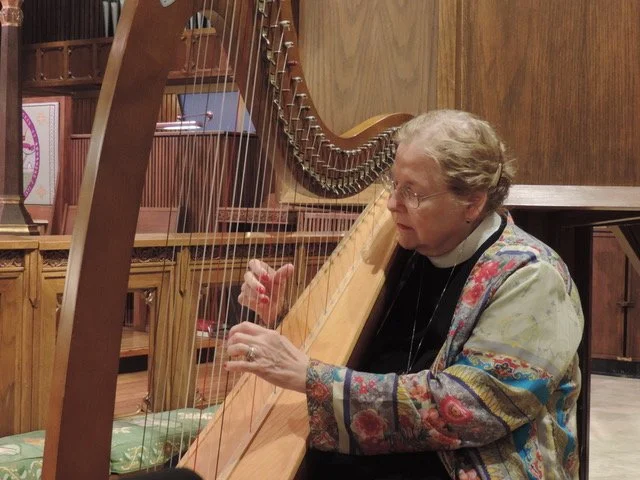
I began a journey with this classical instrument over forty years ago when my daughter begged for a whole year to get a harp.

A Midrash tradition is that David’s harp strings were made out of the tendons of the ram offered as a sacrifice instead of Isaac. The Psalms suggest that David’s harp had seven, eight, or possibly ten strings. This Celtic lever harp has 34 strings, and the larger Troubadour lever harp I play has 36 strings. A full-sized pedal harp has 47 strings.

The strings are the piano’s white keys, so it is easy if you understand the piano. Next, you lean the harp against your body so you can hear the vibrations and feel the music within you. 

The harp has taught me so many lessons about life, other than the discipline of trying to master a technique for following and plucking strings.

When one string breaks, it is challenging to continue playing. Part of playing is knowing the relationships between each string and the others. Now, a gap, large or small, changes the entire road map. It is almost impossible to play with that gap. I must take the time to replace the string as soon as possible. I try to keep remembering how important staying in relationship is. 

Then, it takes days or weeks for that new string to stretch and be in tune. Then, finally, it must be “mentored,” so to speak. 

Almost every atmospheric condition changes the harp strings. Constant tuning is mandatory. My husband loves the old joke about harpists. “We spend half our time tuning and the other half playing out of tune!” 

I have also learned a great deal about listening from my harp. Perhaps you have occasionally noticed a loud buzzing sound when some harpists play. Buzz. One of the reasons for a buzz is that you have plucked a string that is still vibrating from a recent placement of that finger or another finger on that string. You must wait for that string to stop vibrating before you play it again, or this annoying sound develops.

My buzzing harp is reminding me to wait for the person I am meeting with to stop talking before I speak.  

I am learning how to play less buzzing notes and to talk less and listen more at the same time. 

My buzzing harp string has become my icon for listening.

On this musical journey, the harp has become an icon for living, listening, and working in community. 

Its constant need for tuning reminds me how much I must try to stay current, learning, and staying in relationship with what is happening in the world around me. 

If I don’t, I become “out of tune,” either too sharp or too flat. 


I would love to hear from others about life lessons they have learned from a musical instrument.

Joanna joannaseibert.com