Reflections on the Rule - November 2025


Martyrs, Monks, and Mystics

Dr. Brandon Beck

Lay Chaplain, COHI

Monk, The OOOW

Church of reconciliation, san antonio, TX

Theology Student, Brite Divinity School

Christine Valters Paintner, in The Artist’s Rule, a book-guide using The Rule of Benedict and artistic/creative prompts to “nurture your creative soul with monastic wisdom,” describes the Benedictine vow to stability using a quote from Edward C. Sellner’s Finding the Monk Within: “Stability is perceived as an antidote to the restlessness of mind and heart in which a person searches for new experiences, new relationships, and new geographical locations to escape difficulties or to solve problems by avoiding them.” Paintner says that Sellner breaks this stability into three types: “stability of place, stability of community, and stability of heart. (page 71)

I am currently enrolled in a course on the history of spirituality aptly named “Martyrs, Monks, and Mystics.” We’ve read primary texts by and about Perpetua and Felicity, Bernard of Clairvaux, Antony, Guigo, Gregory of Nyssa, Augustine, Mechtild, and Meister Eckhart thus far.

In Chapter One of his Rule, St. Benedict identifies four types of monastics in his time - cenobites, anchorites, sarabites, and gyrovagues:


It is well known that there are four kinds of monastics. The first kind is cenobites, that is, those in monasteries who live under a rule and a superior.

The second kind is anchorites or hermits, that is, those who, no longer in the first fervor of their conversion, but tested by long monastic practice and the help of many others, have already learned to fight against the devil…

The third kind is the sarabites, the most detestable monastics, who have been tested by no rule under the hand of a master, “as gold is tried in the fire,” (cf. Prov 27:21) but have a nature soft as lead. Still keeping faith with the world by their works, they lie to God by their tonsure. Living in twos and threes or even singly, without a shepherd, they are enclosed not in God’s sheepfold but in their own…

The fourth kind is called gyrovagues, who spend their whole lives drifting from one region to another, staying as guests for three or four days at a time in different monasteries. (Sutera’s translation, pages 25-6)

In her commentary, Sr. Sutera shares that Benedict repeats his classifications from Cassian and the Master. She, like Benedict, finds sarabites and gyrovagues to be lacking in the stability and wisdom and spiritual fortitude of cenobites. Sutera comments that “cenobite” is derived from koinonia - Greek for community. (26-7)

I wonder, how would Benedict (and Cassian, the Master, and Sutera) classify these spiritual classics I’ve been studying? They’ve all exhibited stability in their love of Christ and their commitment to live and even die for their beliefs. They’ve all exhibited stability to the community of believers to which they belonged. They’ve all exhibited stability to the place where they lived. Some, like Bernard and Guigo, lived in communities under superiors and rules. Some like Perpetua and Felicity were part of the world; perhaps they were not monks at all. Certainly history has classified them as martyrs and not monks. The definition of sarabite fits them quite well, although I would never consider them as “soft” or as ones who “lie to God.”

Today, a type of monasticism called “21st Century monasticism" or “new monasticism” has gained attention in scholarship. The name and concept is derived from a comment theologian Dietrich Bonhoeffer made in 1935: “The restoration of the church will surely come only from a new type of monasticism which has nothing in common with the old but a complete lack of compromise in a life lived in accordance with the Sermon on the Mount in the discipleship of Christ.” (Bonhoeffer, a letter to his brother Karl-Friedrick 14 Jan 1935) In essence, Bonhoeffer called us all to be sarabites, possibly even gyrovague-sarabites. But in a way vastly different from the way Benedict perceived sarabites and gyrovagues to be. For Bonhoeffer, new monasticism must be very stable - in place, community, and most especially heart.

As members of Community of Hope, International, we are “new monastics” called to “live[] in accordance with the Sermon on the Mount in the discipleship of Christ” when you really look at our mission to “serve others through compassionate listening.”

Listen to the words of the Sermon on the Mount in the NIV:


Blessed are the poor in spirit,
    for theirs is the kingdom of heaven.
Blessed are those who mourn,
    for they will be comforted.
Blessed are the meek,
    for they will inherit the earth.
Blessed are those who hunger and thirst for righteousness,
    for they will be filled.
Blessed are the merciful,
    for they will be shown mercy.
Blessed are the pure in heart,
    for they will see God.
Blessed are the peacemakers,
    for they will be called children of God.
Blessed are those who are persecuted because of righteousness,
    for theirs is the kingdom of heaven.

Blessed are you when people insult you, persecute you and falsely say all kinds of evil against you because of me.

Here we are in the world, not conformed to it but in it, committed to following Jesus’ teachings in order to love each other more. We go from “house to house” listening for the “still small voice of God” in each person we meet. They may be “poor in spirit,” or they may “mourn,” be “meek” or “hunger and thirst for righteousness”; always we are a stable presence listening to them and showing God’s mercy and comfort.

Their “restless mind[s] and heart[s]” can be comforted by our stable willingness to be part of a monastic community that looks a little different than Benedict’s.

I wonder if there’s power in knowing that we’re still doing things the same way even though we’re doing them differently?

Therapy Dogs

Joining the COHI ministry was for us, so to speak, the tail that wagged the dog. We had recently adopted 2 tiny, older fur babies with the intention of training them to therapy and about a year after that, we heard about COHI and decided that it might be a match made in Heaven, so to speak … therapy dogs who cannot talk, involved in a ministry that emphasizes “listening with the ear of your heart.”

And so we entered chaplain training which, as Brother Michael quipped, was simply ‘learning how to show up and shut up.” Seems simple enough, doesn’t it? Well, the show up part is but the shut-up angle takes a lot of training! Humans are not naturally the shut-up type. We love to talk, we love to share, and sometimes we even love to ‘one up’ those to whom we are ministering, which kind of defeats the whole purpose of The Ear of Your Heart thing.

It’s so easy to fall into that trap … sometimes we think we’re just helping our fellow pilgrims by attempting to make their issues seem less stressful by contrasting them with more dramatic examples we’ve heard or experienced. That alone would guarantee that COHI chaplain would not be asked to return. Our pilgrim clients, like us, want to have their issues validated, appreciated, understood and above all, simply….heard. And then again, sometimes we the chaplains get sucked in and simply cannot help but share triggered experiences that we may never have quite resolved, ourselves. That would be another no - no.

Doing a therapy dog ministry cured both of those problems because our two tiny elderly pups stepped up and took the ministry out of our hands and into their own paws, to the extent that I eventually published a book about it entitled “Paw Prints On My Soul.”

We already knew the healing effect therapy dogs had on nursing home and senior center folks, but once we were certified as chaplains, more doors were open to us and to our furry assistants and they pretty much took over the ministry. We were already making therapy visits, as per our and their certification as therapy dogs and handlers. This did make the entire process much easier. We had in essence already performed a 6th month (at least) internship equivalent, so we literally hit the ground running. And that was preceded by an extended dog training/handling course to get the dogs where they needed to be to wear their little red therapy dog jackets and make official visits. That is indeed ‘a whole ‘nother story.!’

The dogs were already certified and visiting and stimulating our elderly and infirm clients, but armed with our new chaplain knowledge and training in listening, we no longer prattled on and on about the dogs, their training or their issues (they had handicaps that did indeed make them more ‘user-friendly). We simply showed up, shut up and let the dogs work their magic.

Of course, we always asked if people wanted a dog-visit. We knew there were folks with fears and/or allergies - but once they nodded, we placed a dog in a lap and the crooning, singsong recitations and often whispered telling of secrets began and we were simply those humans on the other end of the leash….for a while, anyway.

Once the dogs’ cute cuddliness began to break down long-erected barriers, the words began to bubble up from the depths, trickle into sentences and flow more towards us as chaplains and we discovered listening wasn’t that hard…folks had a LOT to say. It didn’t always make a lot of sense, but they had stifled it for a long time; busy caregivers didn’t have the time to listen - then hear it again and again, dementia shorted out wiring in their brains and fried the facts beyond recognition and sometimes what they had to share was too hard to hear…even for them.

The dogs remedied all that. All we had to do was acknowledge that we heard what was being shared, to honor the words and pray with the sharer.

Malawi, Mozambique, and Zambia

August, 2024 to July 2025

REPORTED BY FR. WILLARD KAMANDANI

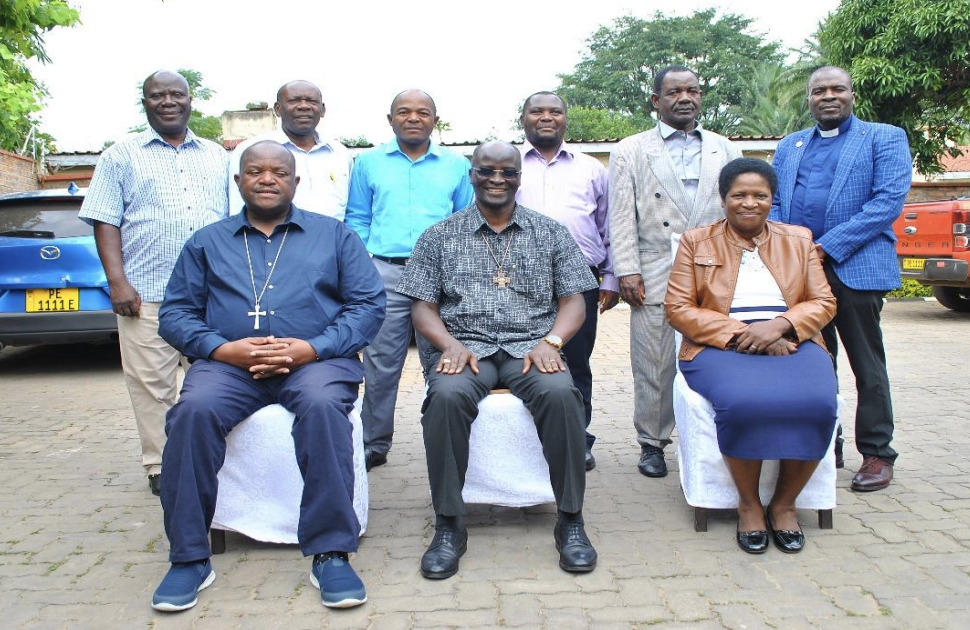
Seated: Bishop Farai from Zimbabwe, Bishop Alinafe Kalemba from Diocese of Southern Malawi, Mrs. Eunice Zamtenge from Lake Malawi Anglican University.

Standing from right to left: Dr. Mundenda from Bishop Gaul Seminary, Fr. Timverane from Leonard Kamungu Theological College, Fr. Jonasi from LAMAU, Fr. Chifunda Phiri from LKTC, Rev. Canon Charles Chiutula, Principal LKTC and Rev. Canon Steven Chibubu from St. John’s Seminary-Zambia.


Community of Hope International in the Diocese of Eastern Zambia

The Church of the Province of Central African covers Botswana, Malawi, Zambia and Zimbabwe. It was inaugurated in 1955. The first Anglican Missionaries arrived in Nyasaland (now Malawi) in 1882. When Malawi became independent in 1964, the diocese of Nyasaland changed its name to diocese of Malawi

WHY COHI IN OUR MALAWI?

COHI was founded by Rev. Dr. Helen Appelberg in 1994 in the US. It was founded to empower the Laity to become actively involved in lay pastoral care, as we know most parishes have more than one station offering an opportunity for lay ministry. The growth of the church is an effort of every member of the Church, not only the clergy. In Malawi, we have parishes with many stations making it tough for one clergy to manage. Members of COHI help the clergy to reach out to the people in need of pastoral services. As our mission statement is to create and sustain Christian communities of lay volunteer pastoral care givers/lay chaplains united in prayer, shaped by Benedictine spirituality, and equipped for and serving in pastoral care ministries.

WHO ARE WE?

Community of Hope International equips lay people to serve in all forms of pastoral care. Pastoral care is when a person is being “present” in a listening, compassionate, non-controlling manner to an individual or group. The purpose is to represent God to them and seeking to respond to their needs. Members learn to match theological insights and spiritual practices with their experiences of ministering to others.

LEADERSHIP STRUCTURE AT NATIONAL LEVEL

The Community of Hope International is growing in Africa. At first, we had COHI only in Malawi but now it has grown and established offices in Mozambique headed by Daliso Liyama and the following members Antonio, Alberto, Elias and Andre. We have COHI Coordinators in all the four Dioceses in Malawi: Fr. Willard Kamandani Diocese of Southern Malawi who is also region coordinator, Fr. Jones D. Zowani Diocese of Northern Malawi, Fr. Rabson Kalulu Diocese of Upper Shire and Fr. Charles Makwenda of Diocese of Lake Malawi.

We have also established centres in Zambia headed by Rev. Canon Steven Chibubu, he is very passionate and helps the centre organization spread very fast in Zambia. Rev. Canon Steven Chibubu is a principle of St. John’s Seminary and he is fighting to integrate the course of lay training into the system.


The following are some of the achievements made within the period of reporting:

  • Registration of the Organization at the Registrar’s office

  • Registration of the Organization at NGORA

  • Registration of the Organization at CONGOMA

  • Establishing three centres in Zambia

  • Establishing five centres in Mozambique

  • Establishing three centres in Zimbabwe and yet to have memorandum of understanding with Bishop Gaul Seminary.

  • Memorandum of understanding in progress between Evangelical Bible College of Malawi and COHI.

  • Memorandum of understanding in progress between Leonard Kamungu Theological College and COHI

A number of leaders from the dioceses started talking about COHI after hearing from Bishop Magangani of the Northern Malawi Diocese, while Rev. Canon Steven of the Diocese of Northern Zambia and many others failed to start online learning due to the failure of network connectivity and many experienced a challenge of internet connectivity too. That led to the creation of the diocesan phase 1 team to be trained as trainer of the trainers so that they can be teaching others in Zambia. Fr. Willard Kamandani agreed with the suggestion of training a team of ordained personnel and non ordained personnel on pastoral care giving and send them out to train others.

The Order of the Benedict (COHI -Malawi) agreed that it will send the learning materials to the diocese to use and adapt the material as needed to fit their situation and time. The COHI would also provide the books from the lists of books such below for the initial group of Eastern Zambia participants in the locally-based program. That will take place alongside some Zambia participants continuing in the US-based Zoom-delivered program.

BENEDICTINE SPIRITUALITY

This is the rule of life written by St. Benedictine of Nursia in 6th Century for the monks of his monastery in Italy. He came up with this rule as an encouragement to those who would seek God together in a community:

The hallmarks of his Rule are:
✓ Balance life- all aspects of life matter
✓ Humility- consider others as more important, and
✓ Hospitality-to see in each other the face of Christ

CIRCLE OF CARE

The circle of care nurtures and sustains members/lay chaplains spiritually as they seek a balanced life between doing for God and being with God. Members gather in the Circle of care to pray and read then reflect on the Rule of Benedictine, share pastoral care experiences, share a meal or refreshments, and provide each other with mutual support and encouragement. Doing the above deepens their spirituality, comforts, heals and gives hope. As of today, we have circles of care in 3 of the 4 Dioceses in Malawi.

TRAININGS

Without the help of COHI America we were able to train 15 groups of 8 members each in the eight out of three countries. After training they went back to their respective Dioceses and conducted trainings for the lay pastoral care givers.

SO FAR, WE HAVE REACHED TO THE FOLLOWING GROUPS

  • Chikwawa Prison: The Prison in Chikwawa, Nsanje and Thyolo have become our partners in this area and we are planning to training them. Our main problem so far is cash flow since we are not funded by the Diocese. We also visited Mulanje Police and Chichiri Prison respectively and we distributed food items, face mask and soap which we received from well-wishers.

  • Chikwawa District Hospital: Misomali Health Centre, Mindanti Health Centre is also one of the government clinics that has shown interest in COHI and we are working with few individuals but we need training for these people as well.

  • Business community: Currently we are meeting and offering some services to JDC Investment on Monday, Wednesday and Friday. This group is unique since it has members from different denominations who works there.

Bishop Frai from Zimbabwe and Rev. Canon Steven Chibubu

Blessing Unaware

Ana McDonald, St. Francis by the Lake, Canyon Lake TX

Walking around the block, I pass my long-time neighbor, a kind, cheerful, musical man. How’re ya doing? I call.

Oooh, fat and not too sassy. His music today is resigned, a bit mournful.

I share the first and hope you’re sassy again soon, I call—I bless—as I walk on.


Perhaps you, as I once did, think of blessing as something the priest does. Maybe something you can do, so long as you include God or Jesus among your words. Or maybe you recite my favorite prayer from Numbers 6: “May the Lord bless you and keep you,…” acknowledging that it is, ultimately, God from whom all blessings come. This is true. All blessings do come from God. But we are God’s instruments, not just in our actions as lay chaplains, but also in the random words we throw into the void.

We bless someone every day. For blessing is “a gift from God, that which gives temporal or spiritual benefit.”* It has meant this since the mid-14th century. Unaware, we scatter blessings—good feelings—wherever we go.

Have a nice day. 

Feel better. 

Safe travels. 

These are blessings. So are random comments that brighten another’s day. 

I like your hair. 

I hadn’t thought of that. 

Thank you so much! 

Even something so simple as a child’s bedtime rhyme is a blessing.

Night Night, sleep tight,
Don’t let the bedbugs bite
But if they do, hit ‘em with a shoe
And say I don’t wanna sleep with you!

Blessings are everywhere around us, endowed by the power of God to make someone’s life a little bit better. In expressing appreciation or hope, in sharing the joy or pain of others, in momentary connections and kindly rituals, we bless those around us. So too, we receive blessings unaware. It needn’t be a big thing, nor even a conscious thing. Like the air we breathe, God is all around us, within us, and we are blessing as we are blessed. 

And so, my friends, I hope that you are feeling sassy. If not now, then soon. 

Amen.


 EtymOnline. Blessing.”

Reflections on the Rule - August 2025


The Parable of the Sower

Dr. Brandon Beck

Lay Chaplain, COHI

Monk, The OOOW

Church of reconciliation, san antonio, TX

Theology Student, Brite Divinity School

The Gospel reading in the Revised Common Lectionary for Proper 13 in Year C of the three year lectionary cycle comes from Luke 12. The passage from Luke 12 read and studied shares the words of Jesus teaching the crowd through what we’ve come to call “The Parable of the Sower.”

Now, Jesus shares this parable in response to a man in the crowd asking him to tell the man’s brother to divide the inheritance between them.

Rev. Reagan Gonzalez, at Church of Reconciliation in San Antonio, TX, shares her insights on this passage in her homily:

This isn’t so much a condemnation of having but of wanting more. Of discontent, of wanting something for the sake of wanting it. The parable doesn’t condemn the man for having barns or for storing food but for wanting more simply for the sake of more. Above all, this man is condemned not for his material possessions alone, nor for desiring to have a good time with friends. Even Jesus indulged in eating, drinking, and merry making all the time. It is his exclusive use of the word “I” and “my” that I believe condemns the man. What should “I” do with all “my” crops? the man asks. “I” will do this. “I” will build larger barns, and “I” will save my soul. The man thinks he can save himself. He thinks he is in charge of his own security, prosperity, and contentment. God asks the man to whom his things will belong after he is gone. He can collect and collect and collect, but one day he will be gone. And what then will his things be worth to him? The man has forgotten to whom he belongs. To whom he owes thanks for all that he has been given.

I wonder if you can put yourself in a place of imagining the world of Italy in the 7th Century? Sitting with a group of 12 others over bowls of soup and hard bread listening to this Parable and some similar interpretation. Silently nodding your head as you eat your meal and think how true it is that this communal life of asceticism to which you’ve vowed your life fulfills the call you’re hearing to have but not want “more simply for the sake of more.” Pausing to thank God for your companions as you realize that you’ve never thought you could journey alone and have always relied on this faith family, this monastic brotherhood in which you live. And, then, you all stop as you hear a knock on the door.

The Rule of Benedict Chapter 53, On the Reception of Guests, teaches:


Let all guests who arrive be received like Christ, 
for He is going to say, 
"I came as a guest, and you received Me" (Matt. 25:35).
And to all let due honor be shown,
especially to the domestics of the faith and to pilgrims. (Paragraph 1)

Let the Abbot give the guests water for their hands;
and let both Abbot and community wash the feet of all guests.
After the washing of the feet let them say this verse:
"We have received Your mercy, O God,
in the midst of Your temple" (Ps. 47[48]:10). (Paragraph 4b)

That’s how I’ve felt this week. The knock on the door was metaphorical, though. In a regional call with other Center Leaders, we read Chapter 53 on Monday, August 4, as assigned by Sister Chittister in her version of the Rule and Commentary. Hearing this chapter while still contemplating Rev. Reagan’s sermon on The Parable of the Sower was my “knock on the door” bringing Benedictine Hospitality into focus in the context of having, not wanting more, and belonging to God while remembering that we are in community in Community of Hope.

No matter who I am called to bring pastoral care to, I answer the call anticipating an encounter with Christ, and I go knowing the full Community of Hope is with me; “I” cannot do anything alone when I am serving the one to whom I belong and to whom I owe all thanks. And I am confident and content with what I have - in skill as well as material - to do the job to which I am called - because God aligns all things for God’s good - just as The Parable of the Sower and On the Reception of Guests aligned this week.

Amen.

Community of Hope International Receives Grant from Trinity Church

August 5, 2025 — Community of Hope International (COHI) is grateful to share some good news: We have received a generous grant from Trinity Church, an Episcopal parish in New York City. This funding will enhance our ability to train lay leaders in faith-anchored skills for pastoral care, ministry sustainability, and community outreach.

This grant is part of Trinity Church’s Spring 2025 Community Grants, a $16.3 million initiative supporting organizations that help people feel seen, safe, and supported. COHI is honored to be part of this caring community of changemakers.

“The decline in ordained clergy, compounded by leader burnout and shifting ministry dynamics, has increased the need for skilled lay leaders to provide pastoral care and spiritual support,” said Sarah Roberts, Board President of Community of Hope International. “This support from Trinity Church allows us to fill this gap by equipping lay leaders with a spiritually grounded framework for leadership to meet pastoral care needs in diverse contexts.”

With this funding, COHI will launch a new effort called Embracing Change: Rooted & Resilient. It’s a way of helping the Church grow strong by preparing lay leaders (those who aren’t ordained but feel called to care) to walk alongside others through life’s joys and struggles. This is especially important now, as fewer clergy are available and many communities are in need of support.

With Trinity’s support, Embracing Change: Rooted & Resilient will focus on three core strategies between 2025 and 2028:

  • Staff and Consultant Engagement: Expand organizational capacity by strengthening partnerships, diversifying revenue, and improving program engagement.

  • Curriculum and Digital Development: Create accessible training resources - including videos, digital guides, and multilingual content - with new modules addressing areas like addiction, divorce, LGBTQIA+ inclusion, and cultural competency.

  • Infrastructure and Governance Strengthening: Deepen board expertise, improve governance practices, and develop regional support networks to ensure sustainable growth.

By 2028, we hope to welcome 100 new centers into our network, train 1,200 more caregivers, and reach thousands of neighbors across the country with encouragement, grace, and hope.

This is all part of COHI’s long-standing mission: Creating communities steeped in Benedictine spirituality, to serve others through compassionate listening.

To read more about Trinity Church’s 2025 grants, visit: https://trinitychurchnyc.org/stories-news/trinity-church-awards-163-million-community-grants-spring-2025-distribution

To learn more about Community of Hope International, visit: cohi.org


About Community of Hope International
Community of Hope International creates communities rooted in Benedictine spirituality, training lay leaders to serve through compassionate listening and presence. Guided by a vision of being a listening presence in the world, COHI helps individuals embody spiritual care in everyday life.

About Trinity Church
Trinity Church is an Episcopal parish in New York City, founded in 1697. Dedicated to justice, mercy, and belonging, Trinity supports worship, education, and philanthropic partnerships with organizations serving people most in need, both locally and globally.