
By: Joanna Seibert
“For the elements changed places with one another,
as on a harp, the notes vary in the nature of the rhythm,
while each note remains the same.” — Wisdom 19:18
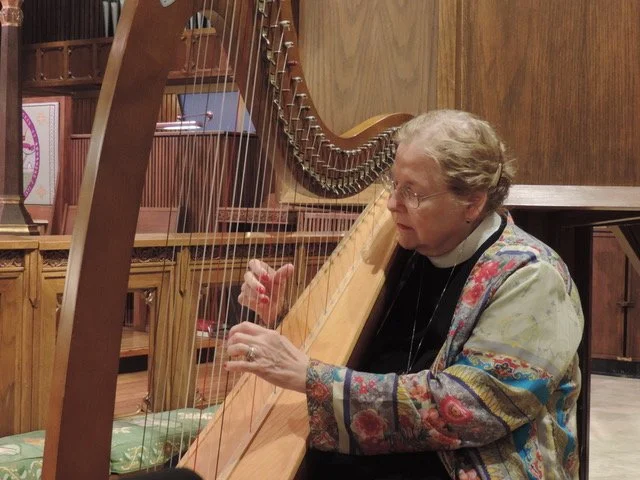
I began a journey with this classical instrument over forty years ago when my daughter begged for a whole year to get a harp.
A Midrash tradition is that David’s harp strings were made out of the tendons of the ram offered as a sacrifice instead of Isaac. The Psalms suggest that David’s harp had seven, eight, or possibly ten strings. This Celtic lever harp has 34 strings, and the larger Troubadour lever harp I play has 36 strings. A full-sized pedal harp has 47 strings.
The strings are the piano’s white keys, so it is easy if you understand the piano. Next, you lean the harp against your body so you can hear the vibrations and feel the music within you.
The harp has taught me so many lessons about life, other than the discipline of trying to master a technique for following and plucking strings.
When one string breaks, it is challenging to continue playing. Part of playing is knowing the relationships between each string and the others. Now, a gap, large or small, changes the entire road map. It is almost impossible to play with that gap. I must take the time to replace the string as soon as possible. I try to keep remembering how important staying in relationship is.
Then, it takes days or weeks for that new string to stretch and be in tune. Then, finally, it must be “mentored,” so to speak.
Almost every atmospheric condition changes the harp strings. Constant tuning is mandatory. My husband loves the old joke about harpists. “We spend half our time tuning and the other half playing out of tune!”
I have also learned a great deal about listening from my harp. Perhaps you have occasionally noticed a loud buzzing sound when some harpists play. Buzz. One of the reasons for a buzz is that you have plucked a string that is still vibrating from a recent placement of that finger or another finger on that string. You must wait for that string to stop vibrating before you play it again, or this annoying sound develops.
My buzzing harp is reminding me to wait for the person I am meeting with to stop talking before I speak.
I am learning how to play less buzzing notes and to talk less and listen more at the same time.
My buzzing harp string has become my icon for listening.
On this musical journey, the harp has become an icon for living, listening, and working in community.
Its constant need for tuning reminds me how much I must try to stay current, learning, and staying in relationship with what is happening in the world around me.
If I don’t, I become “out of tune,” either too sharp or too flat.
I would love to hear from others about life lessons they have learned from a musical instrument.
Joanna joannaseibert.com